
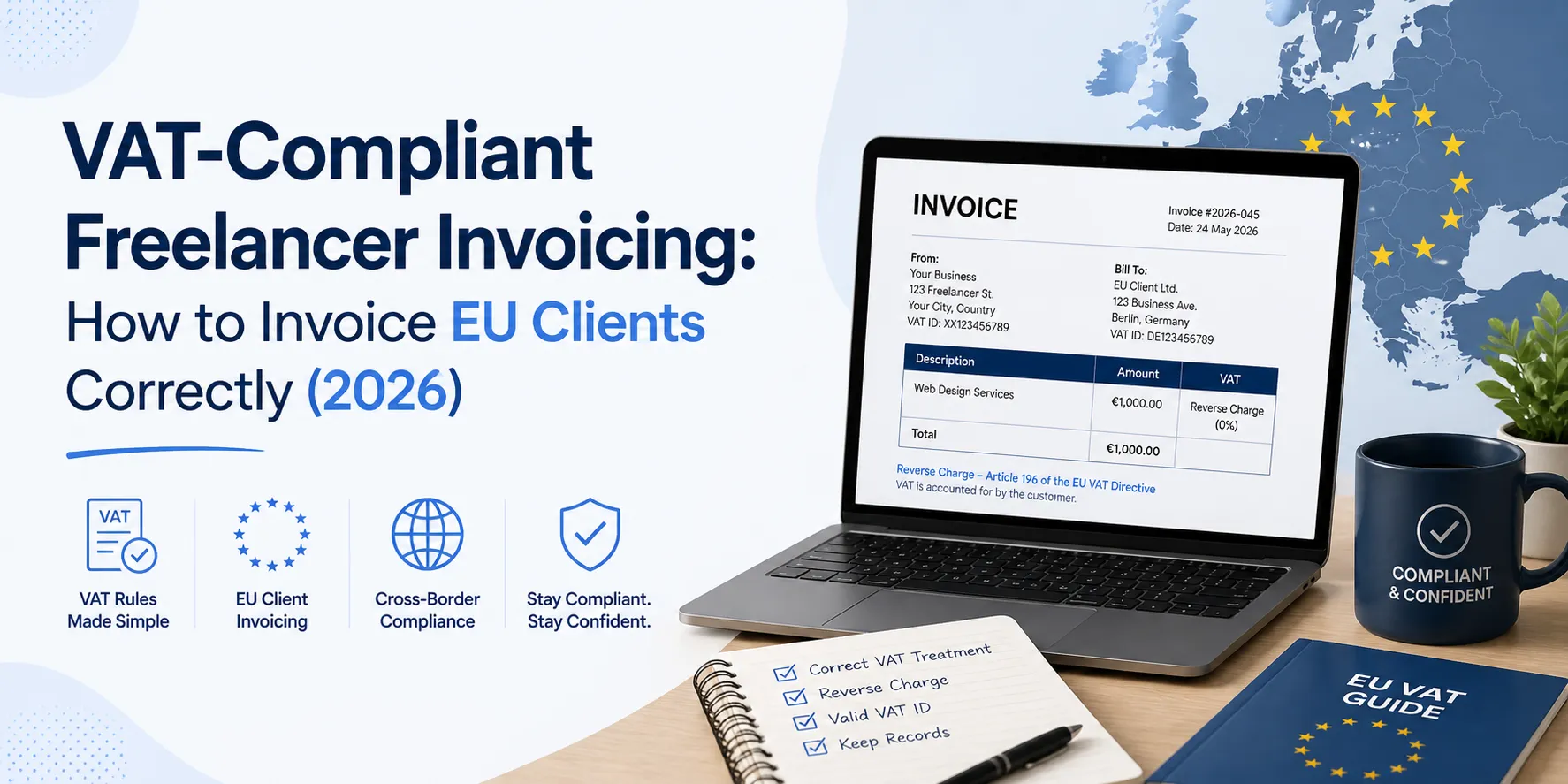
If you're a freelancer working in Europe, your invoicing process is about to change—whether you're ready or not. Poland's mandatory e-invoicing system went live in April 2026, Belgium now requires all B2B invoices through the Peppol network, and the EU's ambitious VAT in the Digital Age (ViDA) initiative is rolling out changes that will affect every self-employed professional operating across borders.
These aren't minor administrative tweaks. They represent the biggest shift in European tax compliance in decades, and freelancers who don't adapt risk penalties, delayed payments, and potential legal headaches. The good news? Understanding these changes now gives you time to prepare and potentially simplify your tax obligations in the process.
What Is ViDA and Why Should Freelancers Care?
VAT in the Digital Age, or ViDA, is the European Union's comprehensive plan to modernise VAT collection and close the estimated €60 billion annual VAT gap. The initiative, which began rolling out in April 2025, introduces three major pillars that directly impact freelancers:
For freelancers who work with clients in multiple EU countries, ViDA promises eventual simplification—one registration to handle VAT obligations across the bloc. However, the transition period means dealing with a patchwork of national systems, each implementing these requirements on different timelines.
The real-time reporting requirement is particularly significant. Instead of quarterly or annual VAT returns, you may soon need to report transaction data within days of issuing an invoice. This shift demands robust accounting systems and potentially new software investments.
Country-by-Country E-Invoicing Requirements in 2026
While ViDA sets the EU-wide direction, individual countries are implementing their own e-invoicing mandates—some far ahead of the 2030 deadline. Here's where things stand for freelancers in major European markets:
Poland: KSeF System Now Mandatory
Poland's National e-Invoice System (KSeF) became mandatory for large taxpayers in February 2026 and expanded to all VAT-registered businesses—including freelancers—in April 2026. Every invoice must be issued through the government platform, which assigns a unique identification number and validates the document in real-time.
With Poland's standard VAT rate at 23%, compliance is non-negotiable. Non-compliant invoices may not be accepted by clients for tax deduction purposes, effectively making your services less attractive to Polish businesses.
Belgium: Peppol Network Required
Since January 2026, all B2B invoices in Belgium must be transmitted through the Peppol network—an international standard for electronic document exchange. Freelancers invoicing Belgian businesses need compatible accounting software or a Peppol access point provider.
Belgium's 21% VAT rate applies to most services, and the tax authorities are actively monitoring compliance through the digital infrastructure.
Italy: Established Pioneer
Italy has required e-invoicing through its Sistema di Interscambio (SDI) since 2019, making it the EU's most mature system. If you work with Italian clients, you likely already use compliant invoicing software. Italy's experience offers a glimpse of what's coming elsewhere: initial adjustment pains followed by smoother, more automated processes.
Germany, France, and Others: Preparing for Transition
Germany and France are developing their e-invoicing frameworks for implementation between 2027 and 2028. Freelancers in these markets have more time but should start evaluating compliant software solutions now. The Netherlands and Spain, while not yet mandating e-invoicing, are expected to follow the ViDA timeline.
VAT Registration Thresholds: Know Your Obligations
Understanding when you must register for VAT remains crucial, as thresholds vary dramatically across Europe:
These thresholds apply to domestic turnover. Cross-border services within the EU follow different rules, typically requiring VAT registration in your home country regardless of turnover when selling to other businesses (B2B) under the reverse charge mechanism.
VAT rates also vary significantly, from Luxembourg's EU-low 16% to Hungary's EU-high 27%. Germany charges 19%, France 20%, and Spain 21%. These differences matter when pricing your services and calculating your actual take-home income.
Practical Steps to Prepare for Compliance
Adapting to these changes doesn't require panic, but it does require action. Here's a practical roadmap for freelancers:
Audit your current invoicing process. Review how you create, send, and store invoices. Paper invoices and basic Word documents won't meet e-invoicing requirements. You need software that can generate structured electronic formats (typically XML-based standards like UBL or CII).
Choose compliant accounting software. Many popular tools—including Holvi, Debitoor, and SumUp Invoices—are updating to support European e-invoicing standards. Verify that your chosen solution supports the specific requirements of countries where you do business, particularly KSeF for Poland and Peppol for Belgium.
Register for relevant VAT schemes. If you work across borders, consider registering for the One-Stop Shop (OSS) to simplify your reporting. This allows you to file a single quarterly return covering all EU member states rather than registering in each country individually.
Set aside funds for potential software costs. While basic compliance tools exist, premium features like automatic reporting and multi-country support may require paid subscriptions ranging from €10-50 monthly.
Keep detailed records. E-invoicing systems typically retain copies, but maintain your own backups. Most EU countries require invoice storage for 7-10 years.
Penalties and Risks of Non-Compliance
The consequences of ignoring these requirements extend beyond fines. In Poland, invoices not issued through KSeF may be deemed invalid, meaning your clients cannot claim VAT deductions—a powerful incentive for them to find compliant suppliers instead. Belgian businesses face penalties of €50-200 per non-compliant invoice.
Beyond direct penalties, non-compliance can trigger VAT audits, delayed payments from clients who require compliant documentation, and reputational damage in markets where digital compliance signals professionalism.
For freelancers working with larger companies, procurement departments increasingly require suppliers to demonstrate tax compliance before onboarding. Your ability to issue proper e-invoices may determine whether you win contracts.
Frequently Asked Questions
Do these e-invoicing rules apply if I'm under the VAT threshold?
It depends on the country. In Poland, KSeF applies to all VAT-registered businesses, but those using the small business exemption may have different requirements. In Belgium, the Peppol mandate targets B2B transactions involving VAT-registered entities. Check your specific country's rules, as some exempt micro-businesses while others don't.
Can I still send PDF invoices to clients?
In countries with e-invoicing mandates, a PDF alone typically won't satisfy legal requirements. You may send a PDF as a courtesy copy, but the official invoice must be transmitted through the designated system (KSeF, Peppol, SDI, etc.). The structured data file is the legal document.
What happens if my client is outside the EU?
E-invoicing mandates generally apply to domestic and intra-EU transactions. Invoices to clients in the US, UK (post-Brexit), or other non-EU countries follow your national requirements but may not need to pass through official e-invoicing platforms. However, keep proper documentation for VAT zero-rating purposes.
How much will compliance cost me as a solo freelancer?
Basic compliant invoicing software starts free or around €5-15 monthly. More comprehensive solutions handling multiple countries and automatic reporting range from €20-50 monthly. Consider this an operational cost like any other business expense—and it's typically tax-deductible.
Conclusion
The shift to mandatory e-invoicing and enhanced VAT reporting represents a fundamental change in how European freelancers manage their tax obligations. While the transition requires effort and potentially some investment in new tools, the long-term benefits include reduced administrative burden, faster payment processing, and simplified cross-border compliance.
Start preparing now rather than scrambling at deadlines. Evaluate your current systems, research compliant software options, and understand the specific requirements for countries where you do business. The freelancers who adapt smoothly will find themselves at a competitive advantage—seen as professional, reliable, and easy to work with in an increasingly digital European marketplace.